

Most HVAC websites don’t have a traffic problem because they have a lead problem. You might be getting visitors, but not enough calls, form fills, or booked jobs. Meanwhile, competitors keep showing up higher on Google and capturing those leads.
From what we’ve seen working with HVAC websites, this usually comes down to one thing: poor on-page SEO for HVAC. If your pages aren’t properly optimized, Google struggles to rank them and potential customers struggle to trust them.
When you fix this, everything changes. You start seeing better rankings, more visibility, and consistent HVAC leads. A strong foundation starts with HVAC search engine optimization, and on-page SEO is one of its most important components for improving long-term rankings and lead generation.
What Is On-Page SEO for HVAC?
On-page SEO for HVAC is the process of optimizing individual pages on HVAC websites such as service pages and location pages using targeted keywords, structured content, and relevant elements to help search engines understand and rank the site for local HVAC searches.
Why Your HVAC Website Needs On-Page SEO to Rank on Google
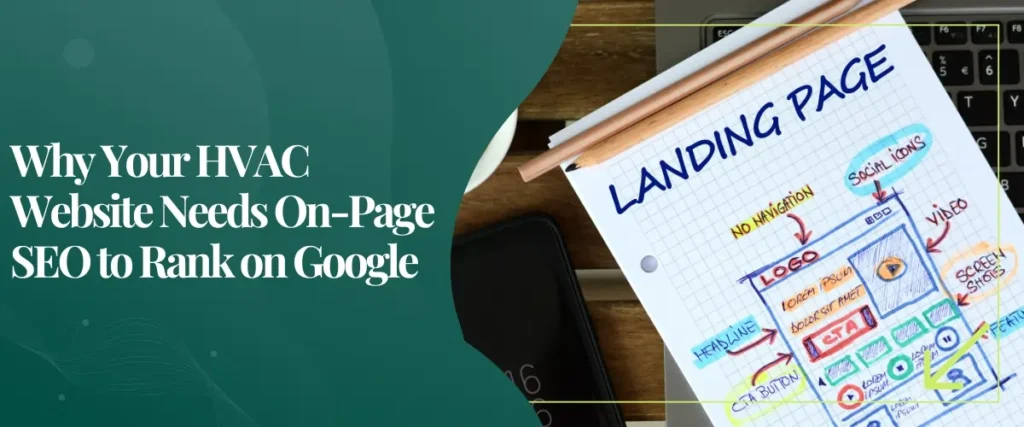
If your website isn’t optimized, Google struggles to understand what your business offers and where you operate. As a result, your pages don’t rank and your potential customers never find you.
From our experience working with HVAC websites, these are the most common issues holding rankings back
- Unclear page targeting: No specific keywords for services like AC repair or furnace installation, so Google doesn’t know what to rank
- Weak content structure: Disorganized headings make it harder for both users and search engines to understand your pages
- Generic content: Doesn’t match what real HVAC customers are searching for
- Missing local signals: No city-based keywords or “near me” relevance, which hurts local SEO
- Poor website optimization: Pages don’t align with search intent, leading to low visibility and engagement
The result? Your competitors show up first, capture the clicks, and get the calls while your website stays invisible.
On-Page SEO for HVAC: 12 Simple Steps to Rank Higher
Here’s a complete, practical on-page SEO checklist for HVAC contractors to improve rankings, increase visibility, and generate consistent leads from Google.
1. Optimize Title Tags for HVAC Pages
Your title tag is one of the strongest ranking factors. We’ve seen many HVAC websites fail to rank simply because titles don’t clearly target a service or location. Include your primary keyword with service relevance so Google understands your page and ranks it for the right searches.
2. Write Compelling Meta Descriptions
Meta descriptions don’t directly affect rankings, but they heavily impact clicks. A weak description means lost traffic even if you rank. Focus on clear benefits, service-specific messaging, and natural keyword use to attract users and increase your click-through rate.
3. Use Proper Heading Structure (H1, H2, H3)
A clear heading structure helps both users and search engines understand your content. Many HVAC sites use poor formatting, which hurts rankings. Use H1 for the main topic and H2/H3 for sections, including keyword variations naturally to improve SEO and readability.
4. Optimize HVAC Service Pages
Each HVAC service should have its own dedicated page. We often see businesses trying to rank one page for everything, which limits visibility. Separate pages for AC repair, furnace repair, and installation improve relevance and help you rank for specific high-intent searches.
5. Target Local Keywords for HVAC Contractors
Local SEO is critical for HVAC businesses. If you’re not targeting city-based or “near me” keywords, your competitors will capture those local leads. Use location-specific terms throughout your content to improve visibility in local searches and attract nearby customers. Local keyword optimization becomes even more effective when it’s part of a complete local SEO for HVAC contractors strategy that strengthens your presence in Google Search and Maps.
6. Improve Content Quality & Relevance
Your content should directly answer what HVAC customers are searching for. Generic content won’t rank or convert. Include real service details, common problems, and helpful explanations using terms like heating, cooling, and repair to improve relevance and trust. Following proven HVAC SEO tips can also help you create content that matches customer intent and performs better in search results.
7. Optimize Images with Alt Tags
Images improve user experience, but without optimization, they add no SEO value. Use descriptive file names and keyword-relevant alt text so search engines understand them. This also improves accessibility and can bring additional traffic through image search results.
8. Internal Linking for Better SEO
Internal linking helps search engines crawl your site and guides users to important pages. Many HVAC websites ignore this and lose ranking potential. Link blogs to service pages and key pages to improve authority, user experience, and conversion paths. Internal linking works best when it’s part of a broader HVAC SEO strategy that improves topical authority and helps search engines understand the relationship between your pages.
9. Add Schema Markup for HVAC Websites
Schema markup helps search engines better understand your business and services. Without it, you miss opportunities for rich results. Adding local business and service schema can improve your visibility in search results and increase trust with potential customers. Pairing schema markup with an optimized Google Business Profile for HVAC can further improve your local visibility and strengthen your presence in Google search results.
10. Improve Website Speed & Mobile Experience
A slow or poorly optimized mobile site drives users away quickly. We’ve seen HVAC sites lose leads simply due to slow loading times. Ensure your website loads fast, works smoothly on mobile, and provides a seamless experience to improve rankings and conversions.
11. Optimize URLs for SEO
Your URLs should be clean, simple, and keyword-focused. Long or confusing URLs reduce clarity for both users and search engines. Use short, descriptive structures like /on-page-seo-for-hvac to improve indexing, readability, and overall SEO performance.
12. Add Clear Calls-to-Action (CTA)
Even if your site ranks, it won’t generate leads without clear CTAs. Many HVAC websites miss this step. Use strong, action-driven phrases like “Get a Free HVAC SEO Audit” to guide users and turn traffic into real calls, inquiries, and booked jobs.
Quick On-Page SEO Checklist for HVAC Contractors
If your HVAC website isn’t ranking, it’s often because key on-page SEO elements are missing. Use this quick checklist to identify gaps and improve your visibility on Google.
- Optimize title tags with HVAC keywords and services
- Write compelling meta descriptions to increase clicks
- Use proper heading structure (H1, H2, H3)
- Create dedicated pages for each HVAC service
- Target local keywords and “near me” searches
- Improve content quality based on customer intent
- Add descriptive image alt tags for SEO
- Use internal linking to connect important pages
- Implement schema markup for better visibility
- Improve website speed and mobile experience
- Optimize URLs with clean, keyword-focused structure
- Add strong calls-to-action to convert visitors
These on-page improvements work even better when combined with other proven HVAC SEO tips that support long-term organic growth.
How On-Page SEO Turns HVAC Traffic into Leads
When your HVAC website is properly optimized, the difference is clear. We’ve seen businesses go from barely getting inquiries to generating consistent leads just by fixing on-page SEO.
- Higher rankings put your business in front of local customers actively searching for HVAC services
- Better content builds trust and makes visitors more likely to contact you
- Improved user experience keeps users engaged and increases conversions
The result? Instead of losing leads to competitors, your website starts generating more calls, more bookings, and steady business growth. This is why businesses that consistently invest in SEO are able to grow their HVAC business with predictable, long-term organic leads instead of relying solely on paid advertising.
Conclusion
On-page SEO for HVAC isn’t just about improving rankings. It’s about turning your website into a consistent lead generation system.
We’ve seen many HVAC businesses struggle with low visibility and missed opportunities simply because their websites weren’t properly optimized. Small improvements in your structure, content, and SEO can make a significant difference in how your business performs on Google.
If you’re ready to stop losing leads to competitors and start getting more calls, the next step is simple:
If you’re ready to stop losing leads to competitors and start getting more calls, request your free HVAC SEO audit and discover exactly what’s preventing your website from reaching its full ranking potential.
Frequently Asked Questions
What is on-page SEO for HVAC contractors?
On-page SEO for HVAC contractors means optimizing service pages, content, and local signals so Google can understand your business, rank your pages higher, and attract more qualified HVAC leads.
How can I optimize my HVAC website for Google?
You can optimize your HVAC website by improving title tags, content quality, local keywords, internal linking, and site speed so your pages rank higher and convert visitors into calls and leads.
Why is my HVAC website not ranking on Google?
Most HVAC websites don’t rank due to poor keyword targeting, weak content, missing local SEO signals, slow speed, or unoptimized pages that fail to match user search intent.
How long does HVAC SEO take to show results?
HVAC SEO typically takes 3 to 6 months to show noticeable results, depending on your competition, website quality, and how consistently you apply on-page and local SEO strategies.
Is SEO worth it for HVAC companies?
Yes, SEO helps HVAC companies generate consistent leads, improve local visibility, and reduce reliance on paid ads, making it one of the most cost-effective long-term marketing strategies.
What are the most important on-page SEO factors for HVAC?
The most important on-page SEO factors include title tags, content quality, local keywords, internal linking, page speed, mobile optimization, and clear service page structure.
Can I do on-page SEO for my HVAC website myself?
Yes, you can handle basic on-page SEO like content updates and keyword optimization, but hiring an HVAC SEO expert helps you avoid mistakes and achieve faster, better results.